The short answer: A delivery drone is a flying courier you rarely see up close. You order in an app, the order is packed and hooked to a drone, and the drone flies itself to your address — usually on autopilot, watched remotely by a human supervisor. Most food drones never land: they hover above your home and lower the parcel on a winch cable or drop it under a small parachute. The whole trip can take under 20 minutes, restaurant to doorstep. In this guide, we break down drone delivery works zomato in plain English — what it is, how it works, and how to use it.
In plain English: Drone delivery is the transport of goods — food, medicines, groceries — by an unmanned aircraft. The drone flies a pre-planned route to a customer’s address, often beyond visual line of sight (BVLOS), meaning the pilot can’t see it and steers it using GPS, sensors and radio links. The package reaches the ground by one of three handoff methods: lowering on a winch cable, dropping under a parachute, or landing at a safe spot. The drone then flies itself back to base to recharge.
Drone Delivery Works Zomato: Why Is Everyone Suddenly Talking About Zomato and Drones?
In October 2026, Zomato founder and CEO Deepinder Goyal replied to a post on X asking whether everyone would end up becoming a delivery worker in the next 15 years. His reply, reported by Indian media, said: “I hope not. We need better jobs. We will look forward to moving to drones when we don’t have enough people for the job.” (The Daily Jagran, 12 Oct 2026). Goyal framed drones as a contingency — something to explore if human delivery partners run short — not a confirmed roadmap.
This isn’t Zomato’s first brush with drones. Back in 2019, the company tested a hybrid drone (rotary and fixed wings on one airframe) after acquiring the Lucknow-based aerospace startup TechEagle. Goyal said at the time: “The only possible way to reduce the average 30.5 minutes to 15 minutes is to take the aerial route, as roads are not efficient for very fast delivery.” (YourStory, June 2019). Rival Swiggy also ran drone trials in 2021 with ANRA Technologies in Etah (Uttar Pradesh) and Rupnagar (Punjab), testing whether packages could fly beyond the operator’s line of sight (Arunachal Observer, Oct 2026). So the idea has been circling Indian food delivery for years — here’s how the mechanics actually work.
How Does a Drone Delivery Work, Step by Step?
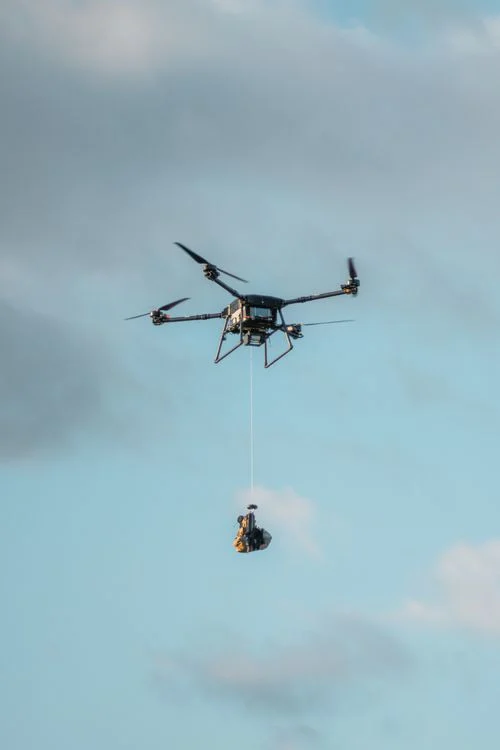
Every drone delivery follows the same five stages:
- Order and dispatch. You order food or goods in an app, exactly as you do today. The restaurant or store accepts the order and packs it into a special lightweight container designed for the drone.
- Loading and pre-flight checks. Staff attach the container to the drone. The flight software plans a route, checks battery, weather and airspace, and clears the flight.
- Takeoff. Fixed-wing drones like Zipline’s original “Zip” launch from a catapult that accelerates them from 0 to about 70 mph in roughly a third of a second; multi-rotor drones like DoorDash’s lift off vertically from a small pad (Drones.R.Africa, UAV Coach).
- The flight. The drone flies itself along its planned route, cruising at roughly 100–130 feet, using GPS, cameras and onboard sensors to avoid obstacles. Because the delivery flies out of sight of its operator, it’s classed as a beyond visual line of sight (BVLOS) flight — and one trained supervisor can monitor many drones at once. Command links ride on cellular networks, the battleground covered in 5G vs 6G: What’s Next for Mobile Networks.
- Drop-off and return. At your address the drone hands off the package — see the three methods below — then turns around and flies itself home to recharge for the next order.
How Do Delivery Drones Hand Off Your Package?
The industry has settled on three ways of getting the parcel from air to ground (sUAS News):
| Method | How it works | Who uses it | Strength |
|---|---|---|---|
| Winch drop | Drone hovers and lowers the parcel on a cable | Wing, DoorDash Air, Manna | Drone never comes near people or obstacles |
| Parachute drop | Drone opens a hatch and the package floats down under a small parachute | Zipline (first generation) | Full control of takeoff and landing points; simple |
| Land and release | Drone touches down on a pad or pre-set spot, releases the parcel, and takes off again | Zipline P2 “droid”, many cargo drones | Precision — Zipline’s P2 droid can hit a patio table |
For homes, the winch has become the favourite: Wing stops at about 23 feet, hovers, and lowers the package on a tether, needing clear ground only the size of a picnic blanket. Zipline’s Platform 2 goes further: the drone stays ~300 feet up while a robotic “droid” steers itself down the tether on thrusters, setting the package down with dinner-plate accuracy (Popular Science, TS2 Tech).
Which Companies Are Already Delivering by Drone?
Drone delivery is past the experiment stage in several markets:
| Company | Where it operates | What’s proven |
|---|---|---|
| Wing (Alphabet) | US, Australia, Ireland, Finland | Over a million commercial deliveries; cruises at 60–65 mph on ~12-mile round trips; average order in under 19 minutes; standard aircraft carries ~2.5 lbs. Walmart partnership targets 270 locations by 2027 (Interesting Engineering). |
| Zipline | Rwanda, Ghana, Nigeria, Kenya, Japan, US | Over 3 million deliveries and 140 million autonomous miles; 30+ municipalities in four US states; “First Flight” program launched in Austin in October 2026 (Securities.io, Oct 2026). |
| DoorDash Air | Pilot in California’s East Bay | Custom six-rotor drone with winch delivery; first partners include Chipotle and Popeyes. Roughly 80% of typical restaurant orders are light enough for the drone; early tests averaged under five minutes, restaurant to doorstep (UAV Coach). |
What’s Stopping Drone Delivery in India?
The technology is ready; the rules are catching up. India’s Drone Rules, 2021 are the framework: nearly 90% of airspace is a “green zone” where drones fly up to 400 feet without permission, every drone needs a Unique Identification Number (UIN), and operations run through the Digital Sky / eGCA platform. As of February 2026, India had registered 38,575 drones and issued 39,890 Remote Pilot Certificates (Press Information Bureau). But there is one big asterisk: India’s type-certification scheme currently covers only visual line of sight (VLOS) flights, and a full regulatory framework for BVLOS operations — the kind a doorstep drone delivery needs — is still being prepared by a DGCA working group (Rajya Sabha reply, Dec 2024). Until that framework lands, Indian drone deliveries will mostly stay inside controlled trial corridors.
A likelier Indian model: Uber’s early concept had drones fly food to a pre-set landing point, from where a conventional rider completes the last leg — “we just have to get it close enough” (Logistics Insider). That hub-and-spoke version could fit India’s dense cities.
What Are the Limits of Drone Delivery?
Honest answer: drones won’t replace the rider with a backpack anytime soon. Payload is the first ceiling — Wing’s standard aircraft carries about 2.5 pounds (roughly a couple of burgers and fries). Weather is the second: heavy monsoon rain grounds flights, and Zipline’s early drones would deploy a parachute for a safe landing rather than risk it. Noise is the third — delivery-drone suburbs have complained about the buzz, and DoorDash’s claim that its drone sounds like “a passing car” from delivery height is one to watch (UAV Coach). And someone still pays for charging infrastructure, maintenance, and remote pilots.
Frequently Asked Questions
Will drones replace Zomato’s delivery riders?
Not imminently. Goyal himself described drones as a fallback “when we don’t have enough people for the job” — a contingency, not a confirmed plan. Payload limits, pending BVLOS regulation, and monsoon weather mean riders stay the backbone for years.
How long does a drone delivery take?
Faster than a bike in traffic. Wing’s average delivery arrives in under 19 minutes, and DoorDash’s early drone tests averaged under five minutes from restaurant to doorstep. Zomato said in 2019 that its average bike delivery took 30.5 minutes — the figure it hoped drones would cut to 15.
Is drone delivery legal in India?
Yes, under the Drone Rules, 2021 — green-zone flights up to 400 feet need no permission, with mandatory UIN registration and pilot certification. But true BVLOS doorstep delivery still awaits a dedicated DGCA framework.
How do drones drop food without breaking it?
They rarely drop it at all. The standard method is a winch: the drone hovers at a safe height and gently lowers the parcel on a cable, or a small droid rides the tether down and sets it on the ground. First-generation Zipline drones used a parachute, which works best for tougher goods like medical supplies.
Can delivery drones fly in rain?
Up to a point. Zipline’s drones handle moderate wind and rain, but severe weather can abort a flight — the drone deploys its parachute for a safe landing instead. Heavy rain and strong gusts remain a key limit.
Want more beginner-friendly tech explainers? Read Temple & Brain-Sensing Wearables, Explained and How Live Translation Works in Google Translate.
Developers, designers and marketers who build websites, software, apps and automations for businesses worldwide. Our editorial policy