The short answer: Satellite internet is broadband delivered from satellites orbiting Earth, instead of cables or cell towers. The two biggest names are SpaceX Starlink, live today with 11,000+ satellites and typical speeds of 50–250 Mbps, and Amazon Leo (formerly Project Kuiper), targeting consumer service around late 2026–2027 with announced speeds up to 400 Mbps–1 Gbps. If you need satellite internet today, Starlink is the only practical option.
What Is Satellite Internet, Exactly?
Definition: Satellite internet is a way of getting online in which data travels between a dish or antenna at your home and satellites in orbit, instead of through fiber cables or cell towers. Modern systems use constellations of low-Earth-orbit (LEO) satellites — hundreds or thousands of small satellites flying a few hundred miles overhead — to deliver broadband-speed connections with low enough latency for video calls, streaming, and even online gaming.
This is not the old satellite TV-style internet from a decade ago. Those legacy services used a handful of huge geostationary (GEO) satellites parked about 36,000 km above the equator, and the sheer distance produced round-trip latencies of 600 milliseconds or more. LEO constellations fly roughly 70 times closer to the ground, which is what makes modern satellite internet feel like “real” broadband.
How Does Satellite Internet Work?
Here are the four steps behind every connection, as described in T-Mobile’s explainer on the technology:
- Your device talks to your dish. Your laptop or phone sends data to a satellite dish or flat-panel antenna at your home — usually a self-aligning terminal.
- The dish beams the signal up. The terminal transmits your request to a LEO satellite passing overhead, roughly 250 to 1,200 miles above the surface.
- The satellite relays it down. The satellite forwards your signal to a ground station plugged into the internet backbone — or to another satellite via laser links in newer systems.
- The process reverses. The data you asked for travels back up to the satellite, down to your dish, and on to your device.
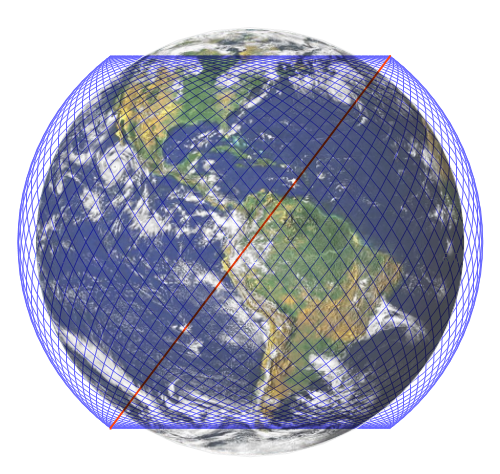
Two things make LEO systems dramatically better than their predecessors. First, altitude: LEO satellites orbit at just 500–1,200 km, cutting round-trip latency from 600+ ms to tens of milliseconds. Second, inter-satellite laser links: satellites hand data to each other in orbit, extending coverage over oceans and areas with no ground stations. Because each fast-moving satellite covers only a small patch of Earth at a time, a single system needs hundreds or thousands of satellites to provide continuous coverage.
What Is Starlink?
Starlink is SpaceX’s LEO satellite internet network — the largest satellite constellation ever deployed. Its satellites orbit at around 550 km, and in typical conditions Starlink delivers downloads of 50–250 Mbps, uploads of 10–30 Mbps, and latency of 20–40 ms.

Starlink’s biggest advantage is its head start: more than 11,000 satellites in orbit as of September 2026 and service in most countries, with a $349 kit and roughly $80–$120 per month for residential plans. On October 6, 2026, the FCC approved SpaceX’s plan to launch 15,000 next-generation satellites for Starlink Mobile — a direct-to-phone service promising up to 150 Mbps per user, versus roughly 4 Mbps on the current version, which runs on about 650 satellites and is accessed in the US through T-Mobile’s T-Satellite plan.
What Is Project Kuiper (Now Called Amazon Leo)?
Project Kuiper is Amazon’s answer to Starlink: a LEO satellite broadband network renamed Amazon Leo in November 2025. Amazon plans a first generation of roughly 3,232 satellites; the first full-scale production launch was April 28, 2025, and by May 2026 about 304 satellites were in orbit.
Here’s where Amazon Leo stands today:
- Status: Testing with select enterprise and government customers. Consumer availability expected in late 2026–2027, rolling out country by country.
- Speed targets: Amazon says Leo will support downloads up to 1 Gbps, with three terminal tiers: Leo Nano (up to 100 Mbps), Leo Pro (up to 400 Mbps), and Leo Ultra (up to 1 Gbps, aimed at enterprise and government).
- Pricing: Not announced, but Amazon says the service will be lower-cost than alternatives, with terminals targeted under $400.
- Cloud edge: Deep AWS integration planned for data storage, analytics, and AI — a natural fit for businesses on Amazon’s cloud.
- Partners: Delta and JetBlue signed on for in-flight Wi-Fi; AT&T, Vodafone, and NASA are also partners.
Amazon has lagged its original regulatory schedule: the FCC required 1,616 satellites in orbit by July 2026, and Amazon asked for an extension that was waived in June 2026. Amazon also claims Leo will deliver six to eight times faster uploads and double the downloads of competitors — company claims until independent testing confirms them.
Starlink vs Amazon Leo: How Do They Compare?
Here is a side-by-side look at where the two systems stand. Note that Amazon Leo’s performance figures are announced targets, not independently measured results, since consumer service is not yet live.
| Feature | Starlink (SpaceX) | Amazon Leo (Amazon) |
|---|---|---|
| Service status | Live in most countries | Enterprise/government testing only; consumer expected late 2026–2027 |
| Satellites in orbit (2026) | 11,000+ | ~300 |
| Planned first generation | 12,000+ approved | ~3,232 |
| Orbit altitude | ~550 km | ~550 km |
| Download speed | 50–250 Mbps (typical, measured) | Up to 400 Mbps / 1 Gbps (announced targets*) |
| Latency | 20–40 ms (measured) | Target: under 50 ms (not yet verified) |
| Hardware | Kit ~$349 | Three terminals announced, under-$400 target; not yet on sale |
| Monthly price | ~$80–$120 | Not announced |
| Standout strength | Proven at scale | AWS integration |
*Amazon Leo figures are company-announced targets, not yet independently measured.
Which One Should You Choose?
- You need satellite internet now: Starlink — the only one you can sign up for today.
- You live somewhere with no fiber or cable: Starlink works well for rural and remote homes — you just need a clear view of the sky, since heavy storms can briefly disrupt the signal.
- Your business runs on AWS: Amazon Leo’s deep AWS integration could make it the smarter long-term pick once it launches.
- You want the lowest price: Amazon promises lower-cost service, but pricing isn’t announced yet — don’t wait on a promise when a working option exists.
Getting started: order a kit, mount the dish with a clear line of sight to the sky, and use the app to fine-tune alignment — usually minutes, no technician needed.
Frequently Asked Questions
Is satellite internet as fast as fiber?
Not quite. Modern LEO satellite internet like Starlink delivers 50–250 Mbps with 20–40 ms latency — excellent for streaming, video calls, and most gaming. Fiber is still faster (250 Mbps to multiple gigabits) with lower latency (5–10 ms). Where fiber or cable exists, they usually win; satellite internet’s strength is reaching places they can’t.
Do I need a special dish for satellite internet?
Yes. You need a provider-supplied terminal — a dish or flat-panel antenna that tracks satellites overhead. Starlink’s self-aligning dish ships in its standard kit. Amazon has announced three Leo terminals (Nano, Pro, and Ultra), but they aren’t on sale to consumers yet.
Is Amazon Leo (Project Kuiper) available to consumers yet?
No. As of October 2026, Amazon Leo is testing with select enterprise and government customers only. Most reporting expects broad consumer rollout around late 2026–2027, country by country.
Does satellite internet work in bad weather?
Mostly, yes — but it needs a clear line of sight to the sky. Light rain and snow are usually fine; severe storms can cause brief drops. Tree cover and tall buildings blocking the dish’s view are a bigger problem than ordinary weather.
Can satellites connect directly to my phone?
That’s the next frontier. On October 6, 2026, the FCC approved SpaceX to launch 15,000 next-generation satellites for a Starlink Mobile direct-to-phone service promising up to 150 Mbps per user — up from about 4 Mbps on the current version, available in the US only through T-Mobile’s T-Satellite plan.
Which is better: Starlink or Amazon Leo?
Need a working connection today? Starlink is the answer — live, tested, and available in most of the world. Amazon Leo is the most credible challenger, with ambitious speed targets and deep AWS integration, but no consumer service, no announced pricing, and roughly 300 satellites versus Starlink’s 11,000+. Worth watching, not waiting for.
The Bottom Line
Satellite internet has grown up from a slow last resort into genuine broadband. Starlink proved the model at scale; Amazon Leo is the first serious rival, and their competition should drive prices down and coverage up. The bottom line for buyers: Starlink is the only system you can order today — Amazon Leo is worth watching, not waiting for.
Keep exploring: What Is USB-C? The One-Cable Standard Explained • When Should You Replace Your Phone? A Practical Guide • How Face ID Works: Apple’s Biometric Security Explained

Developers, designers and marketers who build websites, software, apps and automations for businesses worldwide. Our editorial policy