The short version: Quantum computing is a fundamentally different kind of computing that uses quantum bits (qubits) instead of ordinary bits. Through phenomena like superposition and entanglement, a quantum computer can explore many possible answers at once — potentially far faster than any classical supercomputer for specific problems, like simulating molecules or cracking today’s encryption. It will not replace your laptop or phone. This guide covers what beginners actually need to know. In this guide, we break down quantum computing basics beginners in plain English — what it is, how it works, and how to use it.
Definition
Quantum computing is an emerging field that harnesses quantum mechanics to solve certain problems beyond the ability of even the most powerful classical computers, according to IBM. Instead of bits, it processes information with qubits, which can exist in a combination of 0 and 1 at the same time.
Quantum Computing Basics Beginners: What is quantum computing, exactly?
Your phone and laptop are classical computers: they store everything as bits — each a definite 0 or 1 — and calculate step by step. Quantum computing, an idea first proposed by physicist Richard Feynman in the early 1980s, builds computers out of quantum systems instead, using the strange rules of quantum physics as computational tools. Companies like IBM, Google, and Microsoft have since turned the theory into working prototype machines.
The key point beginners miss: a quantum computer is not just a faster classical computer. It is a different machine for different problems. For browsing the web or running apps, classical computers win every time — and always will. Quantum computers aim at problems classical machines struggle with, like modeling how molecules behave.
How is a qubit different from a regular bit?
A classical bit is like a coin lying flat on a table: heads or tails, 0 or 1. A qubit is like a coin spinning in the air: while it spins, it is genuinely both at once — a weighted combination of 0 and 1 called a superposition. Only when you measure it does it “land” as a definite 0 or 1.
This matters because qubits combine exponentially: two qubits represent four states at once, three represent eight, ten represent 1,024 — and fifty represent over a quadrillion states simultaneously, as one explainer puts it.

What are superposition, entanglement, and interference?
Four quantum phenomena do all the work — here they are in plain English (via IBM):
- Superposition: A qubit holds a combination of 0 and 1 until measured, letting groups of qubits explore many possibilities at once.
- Entanglement: Qubits can be linked so that measuring one instantly tells you about the other — what Einstein called “spooky action at a distance.”
- Interference: IBM calls this “the engine of quantum computing.” Qubit states behave like waves: waves peaking at the right answer amplify each other, while waves at wrong answers cancel out.
- Decoherence: the villain. Any disturbance from the environment — heat, vibration, stray electromagnetic waves — can collapse a qubit’s delicate quantum state. Avoiding decoherence is the central engineering battle of quantum computing.
How do quantum computers actually work?
The hardware: how qubits are built
There is no single winning design yet. Researchers build qubits from several physical systems (IBM):
- Superconducting qubits (IBM, Google): fast circuits of superconducting material with fine-tuned control — but they need extreme cold.
- Trapped-ion qubits (IonQ): individual charged atoms held by electromagnetic fields; long coherence times and precise measurements, but slower.
- Quantum dots: tiny semiconductors trapping a single electron, promising for manufacturing scale-up.
- Photons: particles of light, useful for sending quantum information over fiber-optic cables.
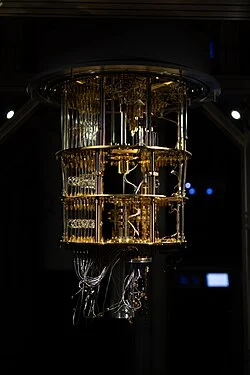
Why do quantum computers need to be so cold?
To fight decoherence, superconducting quantum processors are chilled to roughly a hundred times colder than a single degree above absolute zero using dilution refrigerators. The golden, chandelier-like structure in photos of machines like IBM’s Quantum System One (the first commercial circuit-based quantum computer, introduced in January 2019) is that refrigeration system. A complete installation is about the size of a car, so almost nobody owns one: researchers access quantum computers remotely through the cloud.
Classical vs. quantum: how do they compare?
| Classical computer | Quantum computer | |
|---|---|---|
| Basic unit | Bit: definitely 0 or 1 | Qubit: combination of 0 and 1 until measured |
| How it gains power | More transistors, faster clocks, more cores | More entangled qubits — the state space grows exponentially |
| Best at | Everyday software: browsing, documents, video, databases | Simulating quantum systems, optimization, factoring large numbers |
| Reliability | Extremely reliable bits | Fragile qubits; needs heavy error correction |
| Environment | Runs on your desk | Ultracold, vibration-isolated; usually accessed via cloud |
What can quantum computers actually do?
Today’s machines are still early-stage, but the target applications are concrete. According to IBM, quantum computers are expected to be broadly useful for two kinds of tasks: modeling the behavior of physical systems and finding patterns and structures in information. In practice:
- Drug and materials discovery: simulating molecules to find drug candidates or better battery materials faster than trial-and-error lab work.
- Optimization: logistics, scheduling, and financial modeling problems with enormous numbers of combinations.
- Scientific simulation: modeling quantum systems themselves — from protein folding to new materials — which classical computers can only approximate.
- Cryptography: a quantum algorithm called Shor’s algorithm could one day factor the large numbers underpinning RSA encryption — which brings us to the security question.
Will quantum computers break encryption?
This is where quantum computing already affects you — or at least your servers. A sufficiently powerful quantum computer running Shor’s algorithm could break widely used public-key cryptography (RSA, ECDSA), the math behind SSH logins and website certificates.
Three nuances most headlines skip, per a detailed post-quantum cryptography write-up:
- It only threatens public-key crypto. Symmetric encryption like AES-256 remains secure against known quantum attacks — the transition targets key agreement and signatures, not all encryption.
- Standards already exist. In August 2024, NIST finalized its first three post-quantum cryptography standards: ML-KEM for establishing shared secrets, and ML-DSA and SLH-DSA for digital signatures.
- The migration has started. OpenSSH has shipped hybrid post-quantum key agreement by default since version 9.0, and made
mlkem768x25519-sha256the default in OpenSSH 10.0. The industry is moving because of “harvest now, decrypt later” — attackers can record encrypted traffic today and decrypt it once quantum computers arrive.
Bottom line: no publicly known quantum computer can break today’s encryption — but the security world isn’t waiting to find out.
Can you try a quantum computer today?
Yes — you don’t need a lab. Real quantum processors are available over the cloud, and IBM’s open-source Qiskit software development kit (stable 1.x release in 2024) lets developers write and run quantum programs, with over 600,000 registered users and 700 universities using it for classes, according to IBM. A curious beginner can run a genuine quantum circuit within an afternoon.
Frequently asked questions
What is quantum computing in simple terms?
Computing with qubits instead of bits. Because qubits can be 0 and 1 at the same time and be entangled together, a quantum computer can explore many possible answers in parallel — potentially far faster than classical computers for specific problems like simulating molecules.
How is a qubit different from a classical bit?
A bit is always exactly 0 or 1. A qubit exists in a superposition — a combination of both — until measured, when it collapses to 0 or 1. Qubits can also be entangled, linking their fates in ways classical bits cannot match.
What problems are quantum computers actually good at?
Simulating quantum systems (chemistry, materials, drug discovery), large optimization problems, and certain math problems like factoring large numbers (Shor’s algorithm). They offer no advantage for everyday tasks like web browsing or word processing.
Will quantum computers break all encryption?
They threaten public-key cryptography (RSA, ECDSA), but symmetric encryption like AES-256 is considered secure against known quantum attacks. NIST has already standardized post-quantum algorithms, and OpenSSH ships quantum-resistant key agreement by default.
Will quantum computers replace my laptop or phone?
No. Quantum computers are specialized, cloud-accessed accelerators — roughly car-sized, ultracold installations. Your phone and laptop are classical computers and will stay that way; even their most advanced components, like What Is a Foldable Phone? How Folding Screens Work folding displays, are firmly classical technology.
How can I learn or experiment with quantum computing?
Start with IBM’s free learning resources and the open-source Qiskit SDK to build and run real quantum circuits on cloud hardware. No physics degree required for your first experiment.
The takeaway
Quantum computing is real, progressing, and worth understanding — not because a quantum laptop is coming (it isn’t), but because it will transform fields like drug discovery, materials science, and cryptography. The core ideas fit in a paragraph: qubits hold 0 and 1 at once, entanglement links them, interference amplifies right answers, and extreme cold keeps it all from falling apart. And the quantum era has quietly begun already: the encryption protecting today’s internet traffic is being upgraded for a post-quantum world.
Keep exploring: more from Netra Code’s Technology section — iPhone Duo Explained: Apple’s First Foldable iPhone

Developers, designers and marketers who build websites, software, apps and automations for businesses worldwide. Our editorial policy