Open source software is software whose source code is public: anyone can use it, study how it works, change it, and share their version. It quietly powers much of the modern internet — from the Linux kernel and Firefox to WordPress and the software behind Wikipedia. For beginners, the best part is that this is a world you can explore without writing a single line of code.
What Is Open Source Software in Simple Terms?
it (OSS) is computer software distributed with its source code publicly available, letting users use, study, modify, and distribute it — unlike proprietary software, where the code stays hidden inside the company that made it. These freedoms are granted through open-source licenses, and more rarely by dedication of the code to the public domain (Wikipedia).
it = software whose recipe is public. Anyone can read the recipe, improve it, and share their version — as long as they follow the license’s rules.
A closed-source program is like a restaurant’s secret sauce: you can taste it, but you’ll never see the recipe. Open source hands you the recipe card.
What Are the Four Freedoms of Open Source Software?
The Free Software Foundation defines the essential freedoms every open-source program gives its users (GNU.org):
- Run it for any purpose, no permission needed.
- Study and change it — which is why access to the source code is a precondition.
- Redistribute copies to help your neighbor.
- Distribute your modified versions, so the whole community can benefit from your improvements.
The key word is not “free of charge” but freedom — free speech, not free beer, as the movement’s slogan puts it. Open source can still be sold commercially.
How Does Open Source Software Actually Get Built?
Most open-source projects are built in public, by volunteers and company engineers collaborating across the world on sites like GitHub and GitLab, where anyone can propose changes, report bugs, and review each other’s work (Wikipedia).
In his 1997 essay The Cathedral and the Bazaar, Eric S. Raymond contrasted closed development (“the cathedral”) with the open model (“the bazaar”). His Linus’s Law explains why the bazaar works: given enough eyeballs, all bugs are shallow.
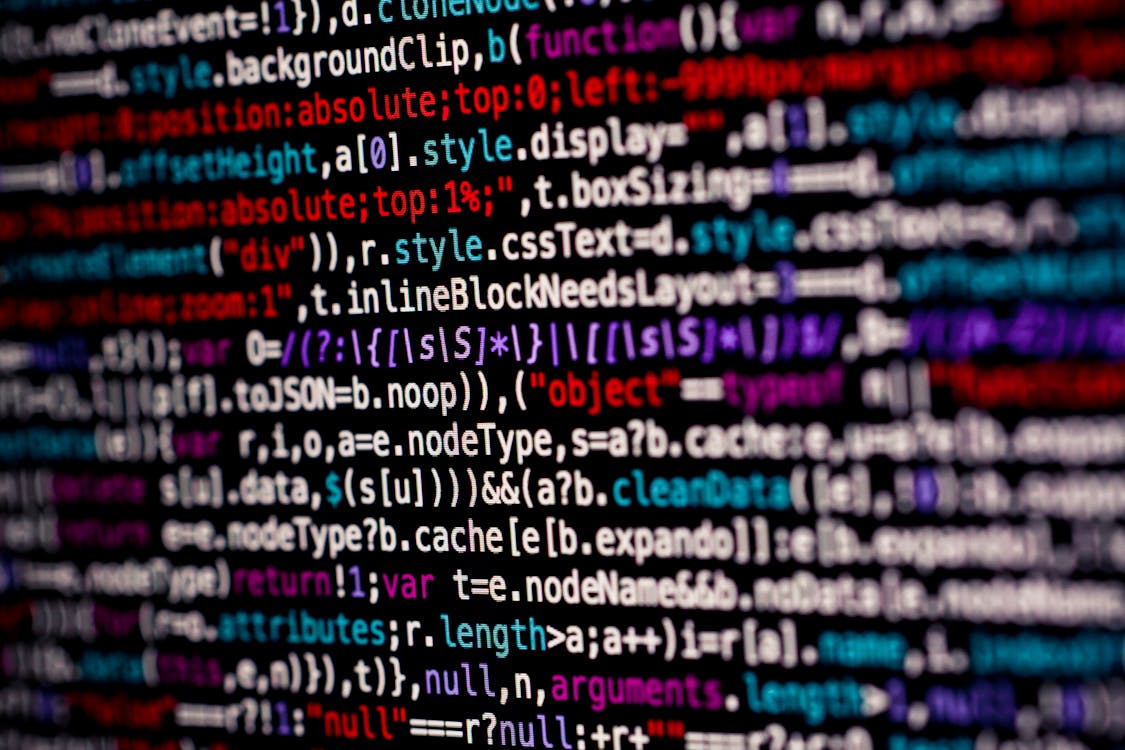
Source code on a screen — the “recipe” anyone can read. Photo by Markus Spiske / Pexels.
What Are Some Examples of Open Source Software?
You probably use open-source software every day. A 2022 estimate suggests 80–96 percent of the code in software on the market today — including proprietary software — is of open-source origin (Wikipedia):
| Software | What it is | Why it matters |
|---|---|---|
| Linux kernel | The core of the Linux operating system | Runs servers, phones (Android), supercomputers, and much of the cloud |
| Mozilla Firefox | Web browser | The mainstream open-source browser, built in public by Mozilla |
| WordPress | Website and blog platform | Powers a huge share of the world’s websites |
| LibreOffice | Free office suite (Writer, Calc, Impress) | A full Microsoft Office alternative |
| VLC media player | Video and audio player | Plays almost any media file, no extra codecs |
| MediaWiki | Wiki software | The software behind Wikipedia |
Linux, Firefox, and MediaWiki rank among the defining open-source projects (Wikipedia), while WordPress and LibreOffice appear on every beginner list (StudySmarter).

Tux, the Linux penguin — mascot of the world’s most famous open-source project. By Larry Ewing / Simon Budig / Garrett LeSage, via Wikimedia Commons (CC0).
Is Open Source Software Really Free?
Usually, yes — most open-source programs cost nothing to download. But the “free” in free and open-source software (FOSS, sometimes FLOSS) refers to liberty, not price. Open-source software can be commercial: companies sell support, hosting, and premium features around open code — the code is free, the expertise isn’t.
One caution: not everything labeled “open” meets the strict definition. The Open Source Initiative, founded in 1998, maintains the Open Source Definition — ten criteria based on the Debian Free Software Guidelines — plus a list of approved licenses. Terms like “source-available” often restrict use or modification, so they don’t qualify as true open source (Wikipedia).
What Do Open Source Licenses Actually Do?
A license is the legal document that grants the four freedoms. The most popular, per the Black Duck KnowledgeBase, are MIT, GPL 2.0 and 3.0, Apache 2.0, and BSD (LiveAbout). The big difference between them:
- Permissive licenses (MIT, Apache 2.0, BSD) let you do almost anything — including building closed commercial products on top of the code — as long as you keep the copyright notice.
- Copyleft licenses (GPL) require that if you distribute a modified version, you must share it under the same open terms. Changes stay open, by law.
For a beginner just using open-source apps, licenses matter little. Check them when you start building or sharing code.
Open Source vs Closed Source: What’s the Difference?
| Open source | Closed source (proprietary) | |
|---|---|---|
| Source code | Publicly available | Kept secret by the vendor |
| Cost | Usually free | Usually paid or ad-supported |
| Modification | You can change and share it | Only the vendor can change it |
| Transparency | Auditable — anyone can inspect the code | Trust-based — you take the vendor’s word |
| Vendor lock-in | Low — the code survives even if the company fails | High — you’re tied to the vendor’s roadmap |
| Examples | Linux, Firefox, WordPress, VLC | Windows, macOS, Photoshop, Microsoft 365 |
Why Is Open Source in the News Right Now?
Open source keeps colliding with the AI era. In May 2026, Flathub — the main app store for Linux Flatpak apps — banned applications containing AI-generated or AI-assisted code, documentation, or other material. In October 2026 it reversed course: developers may submit apps with AI-generated material if they disclose it, identifying the affected parts and their approximate extent (Linuxiac).
The new policy (amended September 4, 2026) draws careful lines: disclosure doesn’t guarantee acceptance — reviewers can still reject apps over quality or maintainability concerns. Flatpak manifests may not contain AI-generated content at all, and developers may not use AI tools or agents to automate submission pull requests, commit messages, or reviews (GamingOnLinux). It’s the open-source community negotiating what “open” means when machines help write the code.
How Can a Beginner Get Started with Open Source?
You don’t need to be a programmer. Here is a practical ladder, from easiest to more involved:
- Use open-source apps daily. Swap in Firefox, VLC, or LibreOffice — or explore a fully open desktop Linux for Beginners: COSMIC Desktop Guide 2026 or Android LineageOS 24: What Is a Custom Android ROM?.
- Learn the tool every project uses. Almost all open-source collaboration runs on Git — start with What Is Git? Version Control Explained Simply.
- Explore code on GitHub. Find a project you use, read its README and issue tracker, and lurk on discussions before touching anything.
- Contribute without code. Beginners are welcome in documentation, translations, bug reports, and testing. A well-written bug report is a genuine contribution.
- Make your first pull request. Many projects label beginner-friendly issues “good first issue.” Fix a typo in docs — it’s a real, merged contribution.
Frequently Asked Questions
Is it safe to use?
Generally, yes — transparency is a safety feature: anyone can audit the code, and popular projects get constant scrutiny. That said, open source is not automatically secure; small, unmaintained projects can harbor bugs. Stick to well-known, actively maintained projects and download from official sources.
Can I sell it?
Yes. Open-source licenses don’t forbid charging — companies routinely sell support, hosting, or enhanced editions around open code. You typically can’t take GPL code, close it up, and sell it as proprietary: copyleft keeps modified versions open.
What’s the difference between open source and free software?
They describe almost the same category of programs but stress different things. “Free software” (Stallman’s 1980s movement) treats user freedom as an ethical issue; “open source” (coined in 1998) stresses practical benefits like code quality (Wikipedia).
Do I need to know how to code to use open source?
No. Millions of people use Firefox, VLC, LibreOffice, or WordPress without ever seeing source code. Coding only becomes relevant if you want to modify a program or contribute to one.
Who owns the code?
Authors keep the copyright and grant rights through the license, so copyright is shared across all contributors. Some projects use contributor license agreements to keep this simpler (Wikipedia).
Is Linux really open source?
Yes — the Linux kernel is released under the GNU General Public License, and its mascot Tux is one of the most recognized symbols of the open-source world. Most Linux distributions combine the kernel with thousands of other open-source programs.
Open source began as a programmers’ experiment in sharing and became the foundation of the digital world. The doors are open — install something open, read something open, and when you’re ready, contribute something back.
Developers, designers and marketers who build websites, software, apps and automations for businesses worldwide. Our editorial policy

2 comments