

A tennis tiebreak is a special short game played when a set is tied at 6 games all, so the set can be decided quickly instead of dragging on indefinitely. The first player (or team) to reach 7 points – leading by at least 2 points – wins the tiebreak, and the set is recorded as 7-6. Points are counted simply as 1, 2, 3 (not 15, 30, 40), and the serve follows a fixed pattern: one player serves the first point, then players alternate every two points. At Grand Slam tournaments, the final set is decided by a longer 10-point tiebreak instead. In this guide, we break down tiebreak tennis format in plain English — what it is, how it works, and how to use it.
Tiebreak Tennis Format: What is a tiebreak in tennis?
In regular tennis, a set is normally won by the first player to take 6 games – but before tiebreaks existed, you had to win by two full games, so an even set could stretch to 14-14 and beyond. The tiebreak solves this by pausing normal game scoring at 6-6 and substituting one compact winner-takes-the-set shootout.
During the tiebreak, everything changes: points are called “one, two, three” instead of 15, 30, 40, and there is no deuce or advantage. If the basics of game scoring still feel mysterious, our guide on Tennis Scoring Explained: Love, Deuce & Tiebreaks walks through 15, 30, 40, deuce, and advantage step by step.
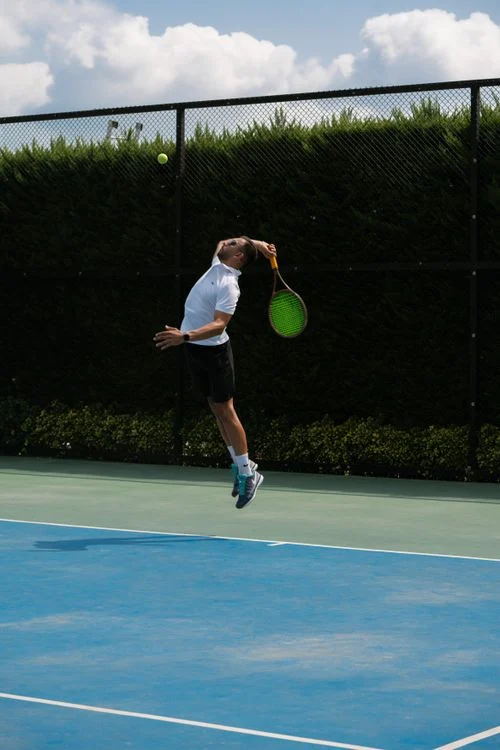
How does a tennis tiebreak work?
The standard tiebreak follows five simple rules, used across professional tours, club leagues, and junior tennis (Tennis Mindset):
- It starts at 6 games all. When neither player has managed a two-game lead by 6-6, the tiebreak begins immediately.
- First to 7 points wins – but you must lead by 2. At 6-6 in the tiebreak, play continues until someone leads by two clear points (8-6, 9-7, and so on). There is no sudden-death point.
- Points are counted 1, 2, 3, 4… Forget 15/30/40 for the duration of the tiebreak.
- The serve rotates in a 1-then-2 pattern. The player whose turn it is to serve starts with a single point, served from the deuce (right) court. Then the opponent serves two points, then the first player serves two, and so on, alternating every two points until the tiebreak ends (Dunholme Tennis Club rules).
- It counts as one game. Winning the tiebreak wins the set 7-6. The player who received first in the tiebreak serves first in the next set.
Who serves first – and how does the serve rotate?
This is the rule beginners ask about most. The player who would have served the 13th game serves the first point of the tiebreak, from the right (deuce) side of the court. After that one point, the other player serves two points – the first from the left (ad) side, then from the right – and the pattern repeats: two serves each, alternating, with odd-numbered points served from the right court and even-numbered points from the left (Dunholme Tennis).
In doubles, the same 1-then-2 rhythm applies, but the four players rotate through the serving order established during that set.
When do players change ends?
Players switch sides of the court after every six points played in the tiebreak – at 6, 12, 18 points, and so on – to keep conditions like sun and wind fair. They also change ends when the tiebreak finishes, before the next set begins.
Tiebreak formats compared
Not every tiebreak is played to 7 points. Here are the three formats you’ll encounter:
| Format | Target | Win by | Where it’s used |
|---|---|---|---|
| Standard tiebreak | 7 points | 2 | Any set reaching 6-6 in most matches, including every set of regular ATP/WTA tour matches |
| Grand Slam final-set tiebreak | 10 points | 2 | The deciding set at 6-6 at all four Grand Slams (since 2022) |
| Match tiebreak (“super tiebreak”) | 10 points | 2 | Often replaces a full deciding third set in doubles and some formats |
What are the tiebreak rules at Grand Slams?
Since 2022, all four Grand Slams – the Australian Open, French Open, Wimbledon, and US Open – use the same rule: if the final set reaches 6-6, a 10-point tiebreak (first to 10, win by 2) decides it, played with the same 1-then-2 serving pattern as a normal tiebreak (Australian Open / Grand Slam Board announcement). Any other set that reaches 6-6 still uses the standard 7-point tiebreak.
Before 2022, each major did its own thing, which confused everyone. The Australian Open led the way with a 10-point final-set tiebreak in 2019. The US Open used a standard 7-pointer at 6-6. Wimbledon waited until 12-12 before playing a 7-point tiebreak. And the French Open had no final-set tiebreak at all – players simply kept going until someone led by two games (EssentiallySports).
The change was driven by marathon matches – most famously the three-day John Isner vs. Nicolas Mahut encounter at Wimbledon in 2010 – and by television schedules. When the Australian Open first adopted the 10-point format, tournament director Craig Tiley said the longer tiebreak was chosen so fans “still get a special finale,” with room for one last twist of momentum (TNT Sports). Because tiebreak outcomes can swing tight matches – and with them, ranking points – it’s worth understanding How Tennis Rankings Work: ATP Points Explained if you follow the tours.
What is a “mini-break”?
A mini-break is simply a point won against the server during a tiebreak. Since serving is such an advantage, the player who collects more mini-breaks almost always wins the tiebreak – it is the entire strategic unit of the format. Coaches tell players to treat return points as gold: one mini-break plus holding your own serves is often enough.
Who invented the tiebreak?
The tiebreak was invented by James “Jimmy” Van Alen, an American from Newport, Rhode Island, who also founded the International Tennis Hall of Fame in 1954 (Wikipedia). He proposed his “Van Alen Streamlined Scoring System” (VASSS) in the early 1950s, unveiled a nine-point version in 1965, and persuaded the US Open to trial it in 1970 (Tennis.com).
That original version was brutal: a best-of-nine sudden-death tiebreak where the first to 5 points won, with no win-by-2 requirement – so both players could hold match point simultaneously on the deciding point. The pros hated it. From 1975 the US Open switched to the now-standard first-to-7, win-by-2 format, and Australia (1971), Wimbledon (1971), and France (1973) adopted versions of the tiebreak too (Tennishead).

5 simple tips for playing tiebreaks
- Start strong. Falling behind early in a short race is hard to recover from.
- Make first serves. A high first-serve percentage decides tiebreaks at every level.
- Attack the second serve. Return points are where mini-breaks happen; step in on weak second serves.
- Pick a side and commit. On big points, decide your target in advance – hesitation loses tiebreaks.
- Reset after every point. The score moves fast and momentum swings wildly; the best tiebreak players treat each point as a fresh start. On close line calls, How Hawk-Eye Works in Tennis: Cameras, Calls & Accuracy systems can review the ball’s landing spot – challenge when you’re genuinely unsure.
Frequently asked questions
How many points is a tiebreak?
A standard tiebreak is played to 7 points, and you must win by at least 2. Grand Slam final sets and many doubles deciding sets use a 10-point tiebreak instead, also win by 2.
What does a score like 7-6(4) mean?
It means the set was won 7-6 via a tiebreak, and the number in brackets is the loser’s tiebreak score – so 7-6(4) means the tiebreak finished 7-4.
Who serves first in a tiebreak?
The player whose turn it is to serve (who would have served the 13th game) serves the first point from the deuce court. Then the serve alternates every two points for the rest of the tiebreak.
Do players change ends during a tiebreak?
Yes – players switch ends after every 6 points played, so neither side benefits unfairly from sun, wind, or court conditions.
What is a 10-point or “super” tiebreak?
A 10-point tiebreak (sometimes called a super tiebreak or match tiebreak) works exactly like a standard tiebreak but is played to 10 points instead of 7, still win by 2. Since 2022 it decides the final set at all Grand Slams, and it’s also commonly used in place of a full third set in doubles.
How long can a tiebreak go on?
There is no maximum length: if neither player can open a 2-point lead, the tiebreak simply continues – 14-12, 20-18, or beyond – until somebody does.

Developers, designers and marketers who build websites, software, apps and automations for businesses worldwide. Our editorial policy

2 comments